



Klear, Inc.
2021 Fillmore Street
San Francisco, CA 94115
+1 (415) 599-7554
The transition nobody planned for
Space companies have historically funded themselves through equity. That model works in R&D mode. But the industry has crossed a threshold: companies that spent years maturing technology are now delivering production hardware on fixed-price government contracts with milestone-based payment schedules. The working capital demands of a $25 million production contract are categorically different from a $2 million prototype award, and most capital stacks were never built for this.
Success, paradoxically, makes it worse. A $15 million contract requires $4 million in long-lead procurement six months before the first milestone payment arrives. Capital risk (the risk that you have the right product, the right customer, and the right contract, but run out of runway before the cash arrives) is what kills companies that should have survived.
Supply chains and government cash flows are compounding the pressure
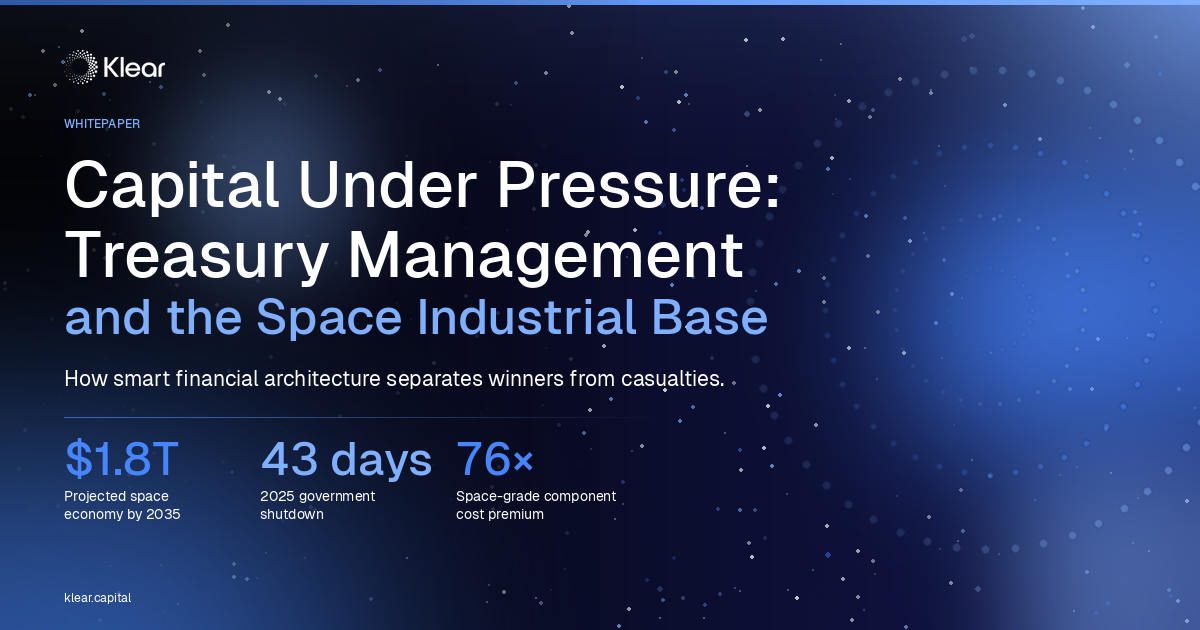
The March 2026 PwC/AIA supply chain report documents a sector under structural strain: carbon-fiber composites with six-month minimum lead times, space-grade switch gears now running 27-month lead times (up from 30 weeks in late 2023), and components that cost 76× their commercial equivalents. These are not anomalies, they are capital commitments that must be made months before corresponding revenue events.
On the government side, continuing resolutions have appeared in 46 of the last 49 federal fiscal years. 2026 opened with a 43-day shutdown. A contract expected to generate cash in Q1 may not produce its first payment until Q3 or Q4. For a company burning $300K per month, that gap requires $1.8 million in unplanned bridge financing from somewhere.
Treasury management is now a strategic function
Our full whitepaper documents five interconnected capabilities every scaling space company needs:
- Cash segmentation across operating, reserve, and strategic pools
- Contract-level cash flow forecasting against milestone and procurement timelines
- Yield optimization on idle capital (a $10M balance can generate $300K–$400K annually at current risk-free rates)
- Counterparty diversification to avoid SVB-style concentration failures
- Working capital planning tied to each new contract before signing
Companies that invest in this infrastructure now will have a durable competitive advantage when supply chains are constrained and government payments are delayed. The rockets are ready. The contracts are coming. The question is whether your capital stack is built for what comes next.
Read the full whitepaper here →