



Klear, Inc.
2021 Fillmore Street
San Francisco, CA 94115
+1 (415) 599-7554
Most founders know what their bank balance is. Fewer know what it's going to be in 45 days, or why it's going to be there.
That gap is the difference between managing capital and guessing at it. And for high-growth companies in manufacturing, defense, aerospace, and the broader industrial supply chain, that gap doesn't just create stress. It creates existential risk.
We built Klear to close that gap. We call the outcome Capital Intelligence, and this post explains what it means, why we believe it's the most important capability a scaling company can develop, and how Klear delivers it.
The Problem Most Finance Tools Don't Solve
Here's a question every founder of a capital-intensive business has asked at some point: Can I afford to fill my next order?
It sounds simple, right?
To answer it honestly, you'd need to know your current cash, when your receivables will actually land, when your payables come due, how long your production cycle takes, and whether any of those timelines will shift. You'd need to understand not just where capital is today, but where it will be when you need it.
Most companies can't really answer that question.
Their operational data lives in one system, their financial data in another, and no single system connects them. So leaders do what they've always done: they estimate, they react, and they hope liquidity holds.
The result? Companies don't usually fail because they lack demand. They fail because their capital plans break under pressure.
The Core Insight: Capital Doesn't Disappear, It Changes State
Here's the philosophical shift that underlies everything Klear builds:
Capital doesn’t disappear, it moves.
Think of it like water. It doesn't disappear, it moves between states: ice, liquid, steam. In a business, capital is doing the same thing, continuously cycling through:
- Cash: liquid, deployable
- Payables: committed capital, cash going out
- Inventory/production: capital in motion, tied up in the fulfillment cycle
- Receivables: earned capital, waiting to be collected
The real question isn't "do we have enough capital?" it's "where is our capital right now, and when will it move back to cash?"
When you stop thinking about capital as a number in your bank account and start thinking about it as something that moves through a system, the entire problem of working capital management changes. It becomes something you can see, model, predict, and control.
What Capital Intelligence Actually Means
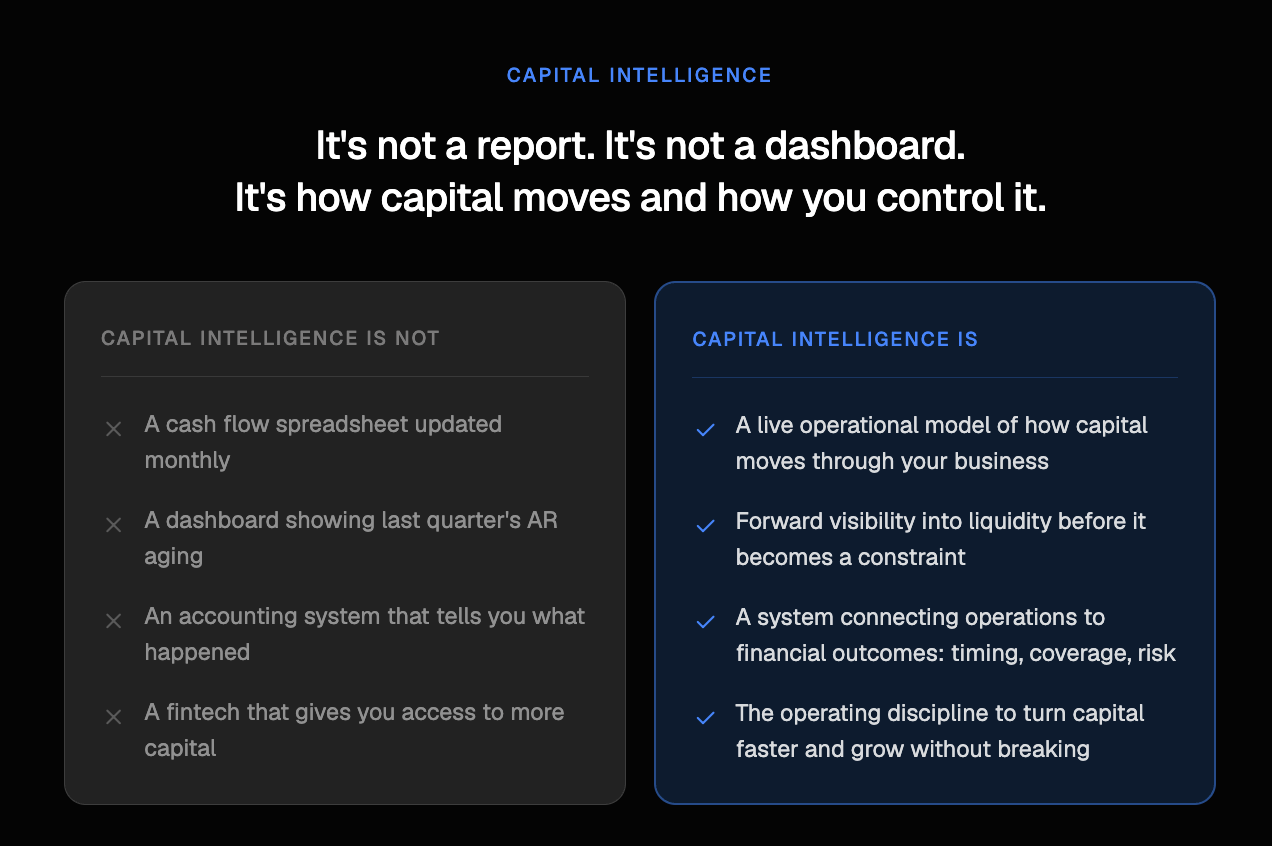
Capital Intelligence is the ability to see where your capital is, predict where it's going, and act before it creates a constraint.
It's the answer to the questions every operator is actually asking:
- Can I afford to fill this order without a cash shortfall in week six?
- When will my receivables convert, and will payroll hold until they do?
- Where in my business is capital getting stuck, and why?
- How fast is my capital actually turning, and what's slowing it down?
These aren't reporting questions. They're real-time capital decisions. And they require a fundamentally different kind of tool than what most finance teams have.
Burns & Turns: The Hidden Constraint on Growth
One of the most important frameworks for understanding working capital is burns and turns: the rate at which a business deploys capital and recovers it.
Every business runs on a loop:
Deploy capital → Convert it → Recover it → Reinvest it
You burn capital to fulfill demand. You turn it when it returns as cash. And growth isn't constrained by how much revenue you can generate — it's constrained by how fast your capital turns.
When capital turns slowly (high Days Inventory Outstanding, high Days Sales Outstanding, misaligned payment terms), you need more working capital to sustain the same level of growth. You're constantly bridging the gap between what you've spent and what you've collected. That bridge costs money — in interest, in equity dilution, or in missed opportunities.
When capital turns faster, everything changes. Less external capital required. Less reliance on expensive debt. More efficient scaling.
Turn faster, grow faster. This is the central operating truth that Capital Intelligence is designed to optimize.
How Klear Delivers Capital Intelligence
Klear delivers Capital Intelligence through three connected systems that together create a Capital Control Loop, which is a continuously updated model of how capital is moving through your business.
Pillar 1: The O2C Engine — Activate Capital
Klear starts where capital decisions actually begin: orders and operational activity.
The moment you accept an order, you've committed future capital. You'll need to purchase inputs, pay suppliers, finance production, and wait for cash to return. But most companies track orders as growth signals, not as capital commitments.
Klear's AI ingestion engine pulls your operational and financial data — purchase orders, invoices, supplier terms, AR, AP, bank activity, milestones — and structures it automatically into Order-to-Cash timelines. The result is a unified, real-time record of where capital is committed and when it's expected to move.
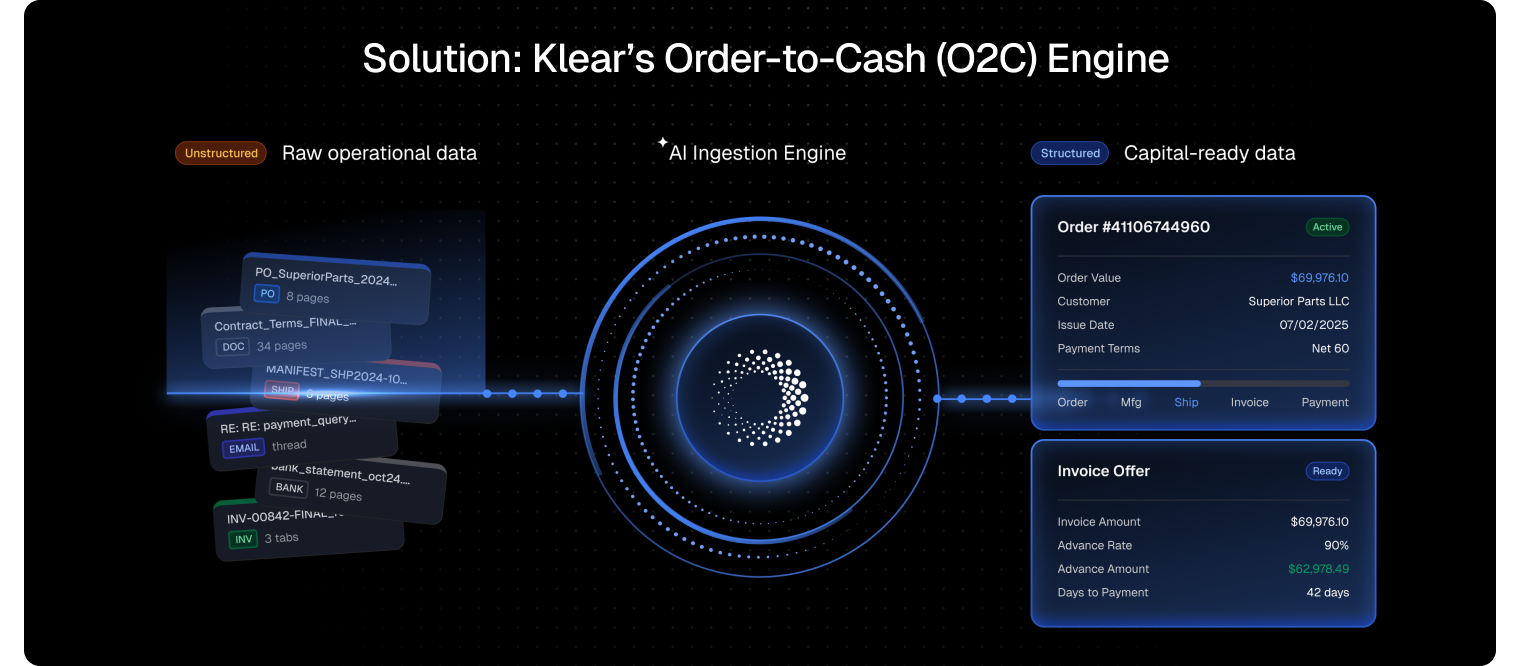
Orders stop being abstract pipeline entries. They become capital decisions.
Klear also embeds execution directly into this system. Companies can pay suppliers, access trade financing, execute international payments, and manage FX, all from within the same platform where capital decisions are made. Every execution event automatically updates the system's understanding of capital state.
Pillar 2: The Live Capital Plan to Predict Capital
Once operational activity is structured, Klear converts it into a live capital plan which creates a forward-looking model that updates automatically as business activity changes.
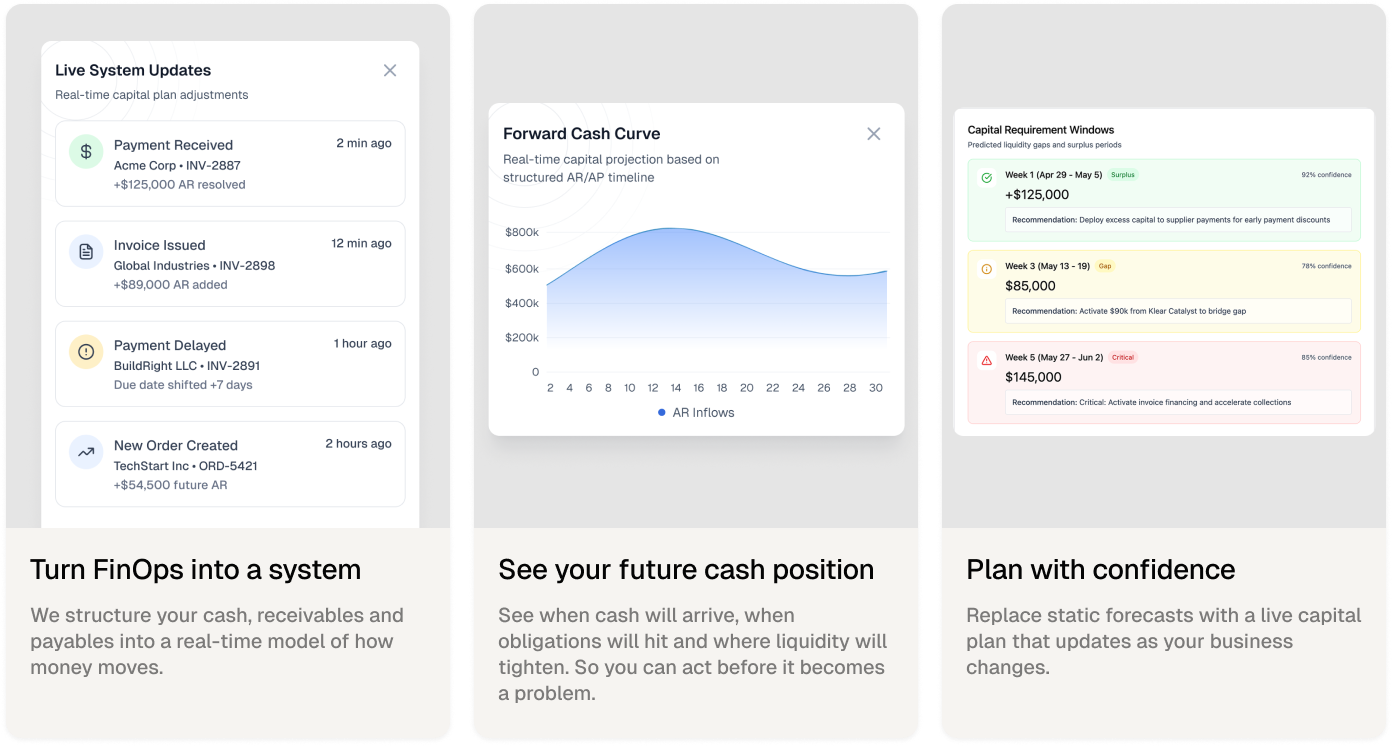
At the core of this model is a simple but powerful equation:
Future Cash = Current Cash + AR − AP
When AR and AP are structured with dates and confidence, future liquidity becomes predictable. Leaders can see:
- When liquidity will tighten, before it does
- How much capital is required to fulfill the current order book
- When specific receivables will convert to cash
- Whether new orders can safely be accepted
- Where capital coverage is thin
This isn't a static budget. It's a live operational model, a heads-up display for capital decisions that updates in real time as your business moves.
Pillar 3: Capital Velocity & CCC Metrics
The ultimate outcome of Capital Intelligence is capital velocity, which is how efficiently money moves through the business and returns to cash.
.png)
Klear measures this through Cash Conversion Cycle (CCC) metrics:
- Days Inventory Outstanding (DIO): how long capital is tied up in inventory and production
- Days Sales Outstanding (DSO): how long it takes to collect after a sale
- Days Payables Outstanding (DPO): how long you can hold capital before paying suppliers
By linking these metrics directly to operational activity, Klear helps companies identify where capital is getting stuck, quantify the cost of that friction, and make the operational changes to turn capital faster.
This transforms capital management from reactive fire-fighting into a measurable operating discipline.
The Trust Layer
Underpinning all three pillars is institutional-grade infrastructure: SOC 2 compliance, audit trails on all capital actions, data ingestion transparency, structured governance and permissions, and institutional reporting for capital providers and leadership. Klear isn't just software. It's capital infrastructure.
The Outcome: Growth Without Capital Breakage
When companies operate with Capital Intelligence, a few things shift permanently:
- Liquidity becomes predictable. You're no longer guessing. You can see 30, 60, and 90 days ahead with enough confidence to make real decisions.
- Decisions become proactive. You're acting before the shortfall, not scrambling after it. You secure financing when you don't need it, not when you're desperate. You extend payment terms from a position of strength.
- Capital turns faster. When you can see where capital is stuck, you can unstick it. Faster turns mean less capital required to sustain growth, and less dependence on expensive external funding.
- External capital becomes optional. When your own capital is working efficiently, the bar for when you need to raise rises significantly. That means better terms, better timing, and more leverage when you do.
The business doesn't react to capital. It runs on it.
Why This Matters Now
The reindustrialization of American manufacturing is creating enormous demand for companies in aerospace, defense, energy, and deep tech supply chains. Order books are growing. Government contract cycles are long.
For the small and mid-sized suppliers doing the actual work, this creates a structural liquidity challenge. They're winning contracts they can't afford to fulfill at the pace their customers require. Not because they lack capability, but because their capital is stuck between states.
Capital Intelligence is the answer to that challenge.
Not more equity. Not another line of credit. A system that makes the capital you already have work harder, move faster, and support the growth you've already earned.
That's what Klear was built to deliver.
Start Running Capital Intelligently
If you're a founder or operator in manufacturing or broader industrial supply chain and you're making capital decisions off incomplete information, we'd like to show you what your business looks like with capital intelligence.
Your next capital decision shouldn't be a guess. See what Capital Intelligence can do — book time with our team →